By Amy Earles
It can be easy to get caught up in our own lives, the here and now. Many people live their lives at a million miles an hour, ticking off an endless to do list and making decisions based on convenience.
But how often do we think about the world we are leaving behind? Today’s children, their children and their children’s children will be inheriting this world. Are we happy with what we’ll be leaving them?
One of Sustainability Options’ core philosophies is to leave a more harmonious world for our grandchildren’s grandchildren. I believe one of the key ways to achieve this vision is to work directly with the younger generation.
I know how influential one day, one person or one event can be in helping you decide the difference you want to make in the world and set you on the path to do just that. Surrounding myself with like minded people in my school environmental group, encouraged me to study a Bachelor of Science (Environmental Sciences) degree which led me to my job at Sustainability Options today.
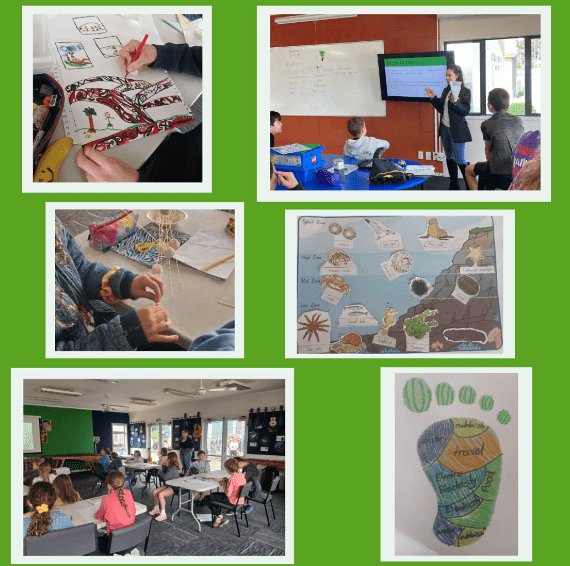
Because of this, I wanted to have an opportunity to visit schools and work with students to see what knowledge they already had, help them learn more about sustainability and the small differences they could each make every day. Over the last 5 years, I have delivered workshops at 3 local schools, working with students aged 5-12 years.
The workshops had a focus on mostly positive climate change messaging. The goal was not to add to climate anxiety, but rather to empower students and encourage their involvement in initiatives to care for the planet. I was impressed by the existing knowledge base many of the students had, their proactivity in getting involved in school and wider community initiatives, such as beach clean ups, and their genuine interest in wanting to learn more. Most of them already cared about the planet, the workshops just ignited this passion even further. I planned the lessons to be engaging and interactive for the students, centered around not just environmental, but also cultural, social and economic sustainability. One of the core concepts of the workshops was to link to the idea that everything is interconnected. Central to this idea is that if our planet is unwell, this can affect us too, akin to the Māori proverb:
‘Ka ora te whenua, ka ora te tāngata.’
When the land is well, the people are well
Different activities in the workshops included building carbon footprints, learning about the lunar planting cycle and Mātauranga Māori, understanding organism distributions in different regions of the rocky shore, learning to use a microscope, using art as a way to express sustainability messages, looking at a restaurant supply chain, problem solving challenges and participating in a treasure hunt that incorporated gardens, chickens and composting areas on school grounds. Feedback from the students in the workshops was very positive and it was a joy to see the excitement on the student’s faces in these sessions.
I would like to thank the University of Waikato, Inspiring Stories and Sustainability Options for their support in my hosting of these workshops in schools. As Whitney Houston once sang:
‘I believe the children are our future, teach them well and let them lead the way’.